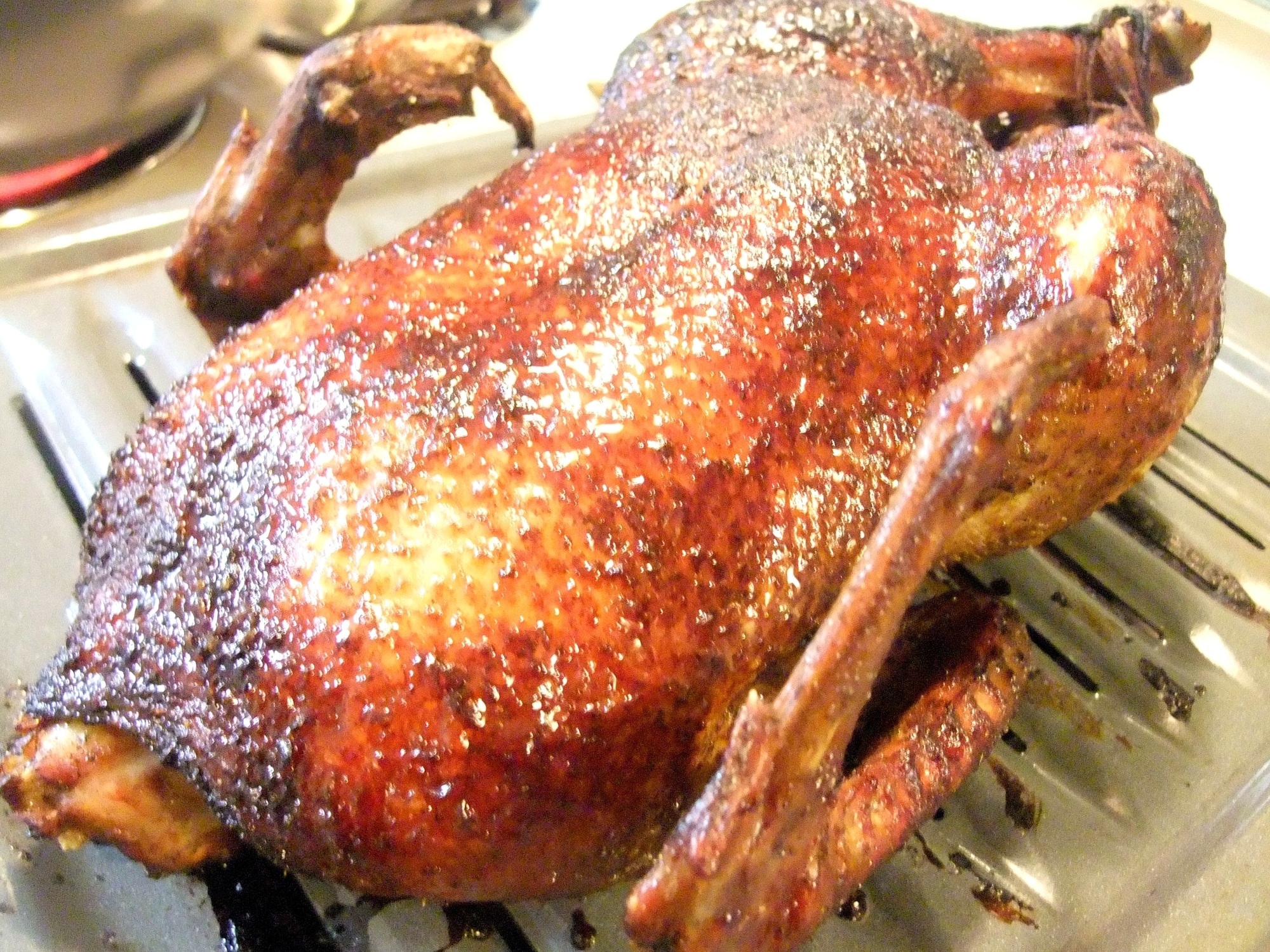
This is a recipe for a slow roasted duck or pato recheado. The recipe comes from Goa, and is another dish to thank the Portuguese for. The recheado masala is a classic Portuguese-inspired ingredient.
The British in India loved this. Goa has wild ducks, and they could go out to shoot their own dinner. More important was the Portuguese influence on Indian cuisine which made this, if not familiar, at least a recognisable dish. It also has chillies, which the British adored.
The British influence on this Portuguese dish is the onion gravy that it is served with. When you get to the recipe you will see it certainly isn’t your expected British onion gravy. Duck fat, masala and stock do not normally feature in British gravies.
From our family’s perspective, this was a special occasion dish. Duck was not readily available at that time in Calcutta. This was a dish that needed planning and preparation.
This is a quite simple recipe, no more difficult than any slow roasted dish. From a cook’s perspective, all you really need to worry about are the 30 minute basting periods.
If you are planning to make this, be aware the duck needs overnight marination in the masala. Further, if you intend to make your own masala, and why wouldn’t you, then that masala needs at least overnight to prepare. Yes, you can buy the masala from an Indian grocer, or, better, make it yourself using our recheado masala recipe.
Scoring the skin will help the duck release fat easier and help create a crispy skin. You need to avoid slicing through to the meat, which will cause the duck to lose moisture. Use a very sharp knife, and be gentle. You might need to slice a few times to get the cut just right. If preparing this for the first time, be aware you can’t really make a big mistake. Cutting too shallow is preferable to cutting too deep.
For the modern audience I have left out the instructions my grandmother provides to remove shotgun pellets.
We never serve this with rice. In Goa this would be served with sanna, or idli as they are more commonly known. I would also serve this with a salad, like spinach and cucumber to provide a balanced meal. The idli are ideal for soaking up the gravy, the duck stands on its own, and the spinach salad helps restore the palate.
the recipe
about
equipment
- paring knife
- skewers
- kitchen twine
- roasting pan
- glass jug
- small saucepan
- hand blender
ingredients
- 1.5 kg duck
- 2 tsp salt
- 200 g recheado masala - see recipe
- 2 red onions
- 1 cup water
instructions
- Remove and discard duck neck and giblets if included. Wash the duck inside and out and carefully dry with kitchen towels.1.5 kg duck
- Use a sharp paring knife to cut the duck skin on the breast and thighs, each cut about 1cm (½ inch) apart. Be careful to just cut the skin, and not into the flesh.
- Rub the duck inside and out with the salt.2 tsp salt
- Cover the duck with some recheado masala, and work well into the skin. Fill the cavity with the remaining recheado masala. Close the cavity and use toothpicks to secure it. Tie the legs together with kitchen twine.200 g recheado masala – see recipe
- Cover, and refrigerate at least overnight.
to cook
- Remove duck from refrigerator and allow at least two hours to come to room temperature.
- Preheat oven to 150 °C, using conventional mode. Do not use fan assistance.
- Peel the onions and remove the stalk and root ends. Halve the onions into two even thick slices each. Place these into the middle of a roasting pan, being careful to not allow them to separate. These will provide a stand for the duck to keep it off the hot surface..2 red onions
- Place the duck, breast side up, on top of the onions in the roasting pan. Carefully pour one cup of water into the side of the pan, ensuring you don’t wash away any of the marinade on the duck. Place any leftover marinade from the marinating dish on top of the duck. Cover, and place into the oven.1 cup water
- Cook the duck for 3½ hours, basting with the pan juices every 30 minutes.
- Once the duck is cooked, remove it from the oven and increase the oven temperature to 225 °C. Baste the duck, as above, and return the duck to the oven, uncovered, for a further 15 minutes, or until the skin is crisp and golden brown.
- Remove the duck from the oven, place breast side up onto the serving dish, untie the legs, cover loosely with aluminium foil and allow to rest for 20 minutes. The skin will get crisper as it rests.
for the gravy
- Pour the pan juices, but not the onion, into a glass jug and place into a refrigerator or freezer for ten minutes. This will help the duck fat to separate from the rest of the juices.
- Once the juices have sufficiently separated, use a small spoon to remove the duck fat until there is about ½ cup left. Set the removed duck fat aside and reserve for other uses. See the notes, below.
- Place the contents of the glass jug, the roasted onion and any remaining pan juices into a small saucepan. Be careful if scraping the roasting pan to not include any burnt material.
- Carefully open the duck cavity, and remove about one tablespoon of the recheado masala and add this to the saucepan.
- Blend the contents of the saucepan into puree, using a hand blender. If the puree is too thick, add a little water to get a thick gravy consistency. Bring the puree to a simmer, but do not allow it to boil. Transfer to a serving jug when hot enough.
to serve
- Serve the whole roast duck with the jug of gravy on the side.
notes
private notes
This feature is only available to subscribers.
A great recipe, which I will be making for Dec 31/2023..
Do you have a cookbook that I can buy?
Hi Gillian – please let me know how it goes?
BTW – no cookbook for purchase. This website is all we have…