slow roasted duck
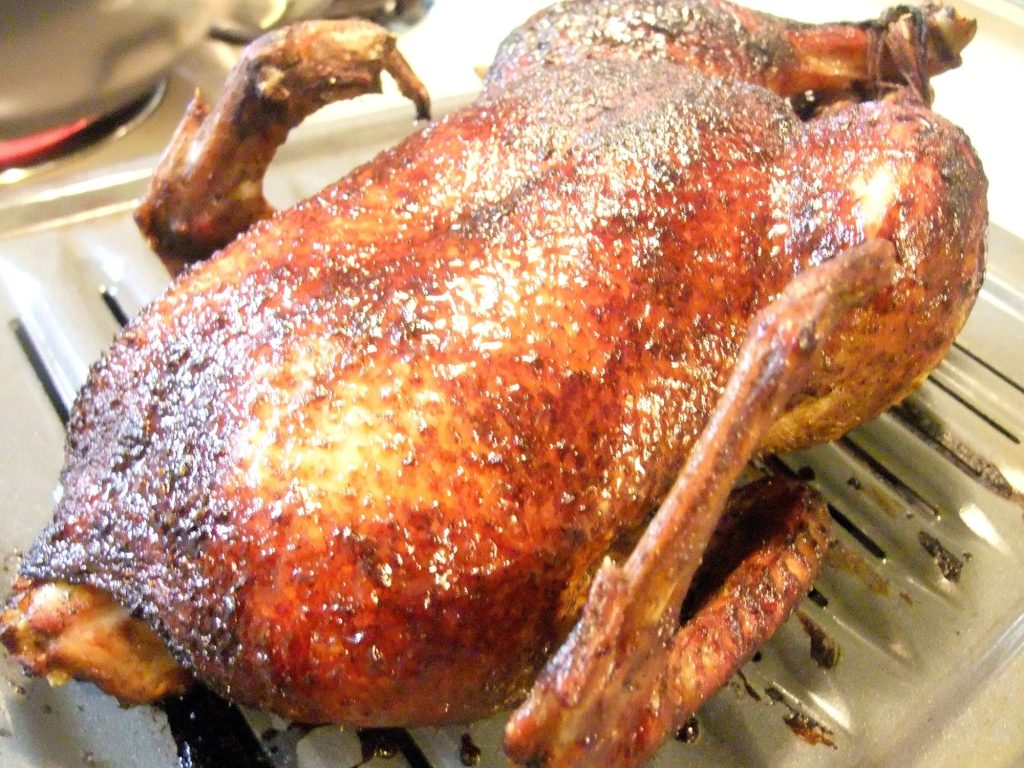
Slow roasted duck, with moist meat, crisp skin and a chilli hit. This is a recipe for duck recheado, or pato recheado. The recipe comes from Goa, and owes its heritage to the Portuguese.
equipment
- paring knife
- skewers
- kitchen twine
- roasting pan
- glass jug
- small saucepan
- hand blender
ingredients
- 1.5 kg duck
- 2 tsp salt
- 200 g recheado masala - see recipe
- 2 red onions
- 1 cup water
instructions
- Remove and discard duck neck and giblets if included. Wash the duck inside and out and carefully dry with kitchen towels.
- Use a sharp paring knife to cut the duck skin on the breast and thighs, each cut about 1cm (½ inch) apart. Be careful to just cut the skin, and not into the flesh.
- Rub the duck inside and out with the salt.
- Cover the duck with some recheado masala, and work well into the skin. Fill the cavity with the remaining recheado masala. Close the cavity and use toothpicks to secure it. Tie the legs together with kitchen twine.
- Cover, and refrigerate at least overnight.
to cook
- Remove duck from refrigerator and allow at least two hours to come to room temperature.
- Preheat oven to 150 °C, using conventional mode. Do not use fan assistance.
- Peel the onions and remove the stalk and root ends. Halve the onions into two even thick slices each. Place these into the middle of a roasting pan, being careful to not allow them to separate. These will provide a stand for the duck to keep it off the hot surface..
- Place the duck, breast side up, on top of the onions in the roasting pan. Carefully pour one cup of water into the side of the pan, ensuring you don’t wash away any of the marinade on the duck. Place any leftover marinade from the marinating dish on top of the duck. Cover, and place into the oven.
- Cook the duck for 3½ hours, basting with the pan juices every 30 minutes.
- Once the duck is cooked, remove it from the oven and increase the oven temperature to 225 °C. Baste the duck, as above, and return the duck to the oven, uncovered, for a further 15 minutes, or until the skin is crisp and golden brown.
- Remove the duck from the oven, place breast side up onto the serving dish, untie the legs, cover loosely with aluminium foil and allow to rest for 20 minutes. The skin will get crisper as it rests.
for the gravy
- Pour the pan juices, but not the onion, into a glass jug and place into a refrigerator or freezer for ten minutes. This will help the duck fat to separate from the rest of the juices.
- Once the juices have sufficiently separated, use a small spoon to remove the duck fat until there is about ½ cup left. Set the removed duck fat aside and reserve for other uses. See the notes, below.
- Place the contents of the glass jug, the roasted onion and any remaining pan juices into a small saucepan. Be careful if scraping the roasting pan to not include any burnt material.
- Carefully open the duck cavity, and remove about one tablespoon of the recheado masala and add this to the saucepan.
- Blend the contents of the saucepan into puree, using a hand blender. If the puree is too thick, add a little water to get a thick gravy consistency. Bring the puree to a simmer, but do not allow it to boil. Transfer to a serving jug when hot enough.
to serve
- Serve the whole roast duck with the jug of gravy on the side.
notes
Scoring the skin will help the duck release its fat and create a crisp skin. Be very careful to cut just the skin, not the flesh.
Wild duck does not have the same amount of fat layered under the skin as a commercial duck. If using a wild duck do not score the skin as specified. Equally, there may not be much fat to remove when making the sauce.
A commercial duck of the specified size will release up to 2 cups of duck fat. The reserving step will likely give you about one cup of duck fat. Be aware that it will be strongly flavoured by the recheado masala.
private notes
This feature is only available to subscribers.
nutrition
Serving: 225 g | Calories: 1063 kcal | Carbohydrates: 6 g | Protein: 30 g | Fat: 101 g | Saturated Fat: 34 g | Polyunsaturated Fat: 13 g | Monounsaturated Fat: 48 g | Cholesterol: 190 mg | Sodium: 948 mg | Potassium: 576 mg | Fiber: 2 g | Sugar: 4 g | Vitamin A: 5671 IU | Vitamin C: 13 mg | Vitamin D: 2 µg | Calcium: 84 mg | Iron: 7 mg

All rights reserved.
Printed on 20 September 2026
To see the online version scan the QR code or visit https://cookbook.pfeiffernet.dev/duck-recheado/