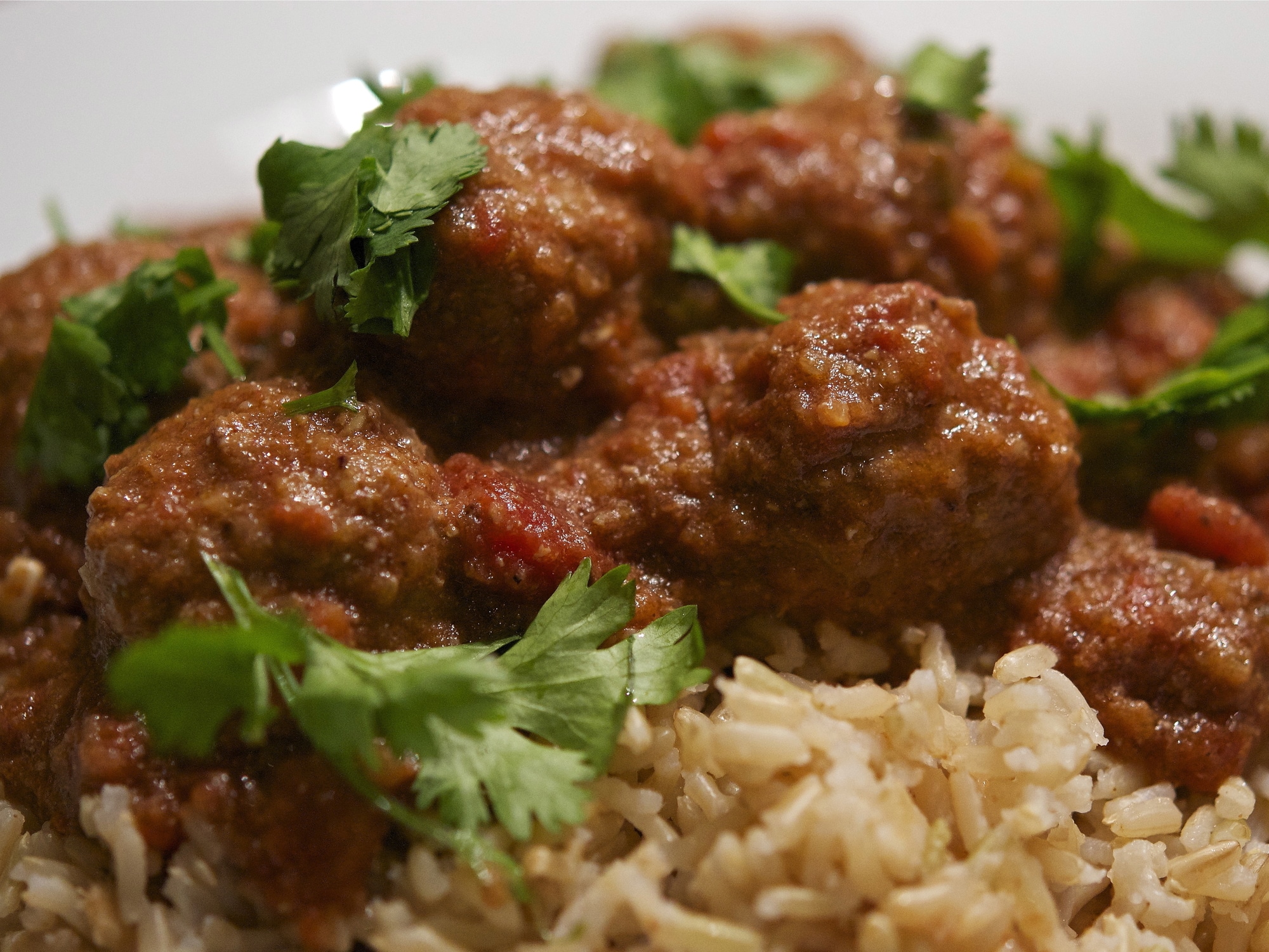
Known as kari kola urundai kuzhambu, this recipe for kofta curry is a Chettinad specialty.
There is something about meatballs that only meat-eaters can understand. Done as this recipe suggests, you have some fragrant, moderately spiced meatballs in a spicy gravy.
You need to make the right-sized koftas. Golf-ball sized koftas are too small, and cricket balls are too big. As described in the recipe you have twelve koftas, about the size of billiard balls. Just right for six people.
Having said that, you could make cocktail sized koftas for finger-food. Make them at golf ball size, and reduce the cooking time appropriately. You might not bother making the gravy, and just serve them straight from the oven. You could also prepare the gravy and use it as a dipping sauce.
This recipe for the koftas is very like recipes from the Mediterranean and the Arab world. Minced lamb, mint and spices is a common preparation from Spain through Greece and across to the Northern African countries. This may well be the influence of Alexander the Great.
However, the sauce or gravy they are in is decidedly Indian.
This is the dish that started my love of Indian food. My father intoduced me to kofta curry when a colleague of his gave him a pot of this to bring home. His wife had cooked it, and they gave us the leftovers. In today’s terminology I suppose we would call it a “care pack”. I was a teenager, and had eaten Indian food before, but this was something from another world. My father said it took him back to his teenage years, when this was considered his special dish. It was cooked for him on his special occasions, such as returning home for a break from boarding school.
He would tell me of coming home, going down to the kitchen and hoping this was being prepared, as it often was. The cook would then cook him a kofta and a chapati as his snack, whilst the rest of the meal was being prepared. This is such an evocative story that it resonates with me, even though I wasn’t there.
My grandmother’s notebook refers to this as “Trevor’s curry”. Her recipe is a bit different to this recipe. She has the koftas deep fried, rather than baked. For a modern audience, I think this is a better approach, in that is healthier and probably allows the delicate flavours in the kofta to stand out.
I am amazed at how rarely I see this dish in Indian restaurants. It lends itself to preparing in advance, and the sauce could well be made in curry house style. As presented here it is a family recipe and is well suited to a special dinner.
You will need to start this recipe at least the day before to marinate the lamb.
So you are a vegetarian, and have read this far? Well, as it happens there is a vegetarian recipe in this book, called malai subzi kofta that just may suit your needs.
This recipe is best suited to serving with plain rice or chapatis, and a kachumber to cut through the creaminess of the gravy.
the recipe
about
equipment
- small pan
- large bowl
- baking tray
- wide pan with lid
ingredients
- 800 g lamb leg - minced
for the marinade
- 2 tsp coriander seeds
- 2 tsp cumin seeds
- 1 brown onion - grated
- 25 g ginger - grated
- 1 tsp garam masala
- ½ tsp Kashmiri chilli powder
- 1 tsp salt
- 1 cup coriander stalks - finely chopped
- 1 cup mint leaves - finely chopped
- 3 tbsp yoghurt
for the koftas
- ½ cup chickpea flour - (besan)
for the gravy
- 1 tbsp coriander seeds
- 2 tbsp mustard oil
- 1 tsp black mustard seeds
- 1 tsp fennel seeds
- 12 curry leaves
- 3 dried Kashmiri chillies - broken into pieces
- 1 brown onion - chopped
- ½ tsp salt
- 1 tsp ground turmeric
- 400 g tomato - seeds and pulp removed, chopped
- 4 cloves garlic - minced
- 250 ml water
- ½ tsp Kashmiri chilli powder
- 250 ml tamarind water
for serving
- 200 ml thick coconut milk
- salt - to taste
- 1 cup coriander leaves
instructions
preparation
- Heat a small pan over medium heat. Once hot, put the coriander and cumin seeds into the heated pan. Toast the spices until they become aromatic. This will only take a few minutes. Remove from heat, allow to cool, then grind to a fine powder.2 tsp coriander seeds, 2 tsp cumin seeds
- Put the lamb mince in a large bowl. Add the ground coriander and cumin seeds, onion, ginger, garam masala, chilli powder, salt, coriander stalks, mint and yoghurt. Mix well. Cover and refrigerate at least overnight.1 brown onion – grated, 25 g ginger – grated, 1 tsp garam masala, ½ tsp Kashmiri chilli powder, 1 tsp salt, 1 cup coriander stalks – finely chopped, 1 cup mint leaves – finely chopped, 3 tbsp yoghurt, 800 g lamb leg – minced
to make the koftas
- Pre-heat oven to 175 °C
- Take the mixture and divide it into 12 equal portions. Wet your hand and form each into a ball. Now, with dry hands, dust with chickpea flour, and gently shape again.½ cup chickpea flour – (besan)
- Line a baking tray with greaseproof paper. Place the koftas on the tray in a single layer and bake for 30 minutes, turning every 5 minutes to make sure that the koftas retain their ball shape. Set aside in a warm place once cooked.
to make the gravy
- Heat a small pan over medium heat. Once hot, put the coriander seeds into the heated pan. Toast them until they become aromatic. This will only take a few minutes. Remove from heat and allow to cool, then grind them to a fine powder and set aside1 tbsp coriander seeds
- Heat the mustard oil in a pan big enough to just take the cooked koftas in a single layer. A 24cm (9½ inch) pan should suffice.2 tbsp mustard oil
- When the mustard oil stops smoking and appears translucent, remove it from the heat and allow it to cool a little. Add the mustard seeds, fennel seeds, curry leaves and dried chillies. Return to heat, and cook until mustard seeds begin to splutter.1 tsp black mustard seeds, 1 tsp fennel seeds, 12 curry leaves, 3 dried Kashmiri chillies – broken into pieces
- Add the onions, sprinkle with the salt and cook for ten minutes, stirring frequently until the onions start to brown at the edges.1 brown onion – chopped, ½ tsp salt
- Add the turmeric, tomatoes, garlic and the water and mix well. Simmer until the tomatoes soften and the oil starts to separate from the mixture. This will take about ten minutes.1 tsp ground turmeric, 400 g tomato – seeds and pulp removed, chopped, 4 cloves garlic – minced, 250 ml water
- Add the Kashmiri chilli powder and ground coriander seeds. Stir well and cook for another two minutes.½ tsp Kashmiri chilli powder
- Add the tamarind water and cook for a further two minutes.250 ml tamarind water
- Using a vegetable masher or a stick blender, puree the gravy, getting as many large pieces of tomato reduced. Bring to a boil, then reduce heat to a very low simmer.
- Add the juices from the cooked koftas to the mixture, then mix well. Gently add the koftas in a single layer, ensuring they are coated with the sauce.
- Cover the pan and poach the koftas in the gravy for 20 minutes, gently turning them every five minutes.
to serve
- Remove the koftas from the gravy, and place them into a warm serving dish.
- Stir the gravy, and slowly add the coconut milk. Season with salt, if needed, and bring to a simmer. Do not overheat the sauce as the coconut milk will separate.200 ml thick coconut milk, salt – to taste
- Pour the gravy over the koftas, then sprinkle with coriander leaves and serve.1 cup coriander leaves
notes
private notes
This feature is only available to subscribers.
will try at the weekend, lots of love jennyxxjj