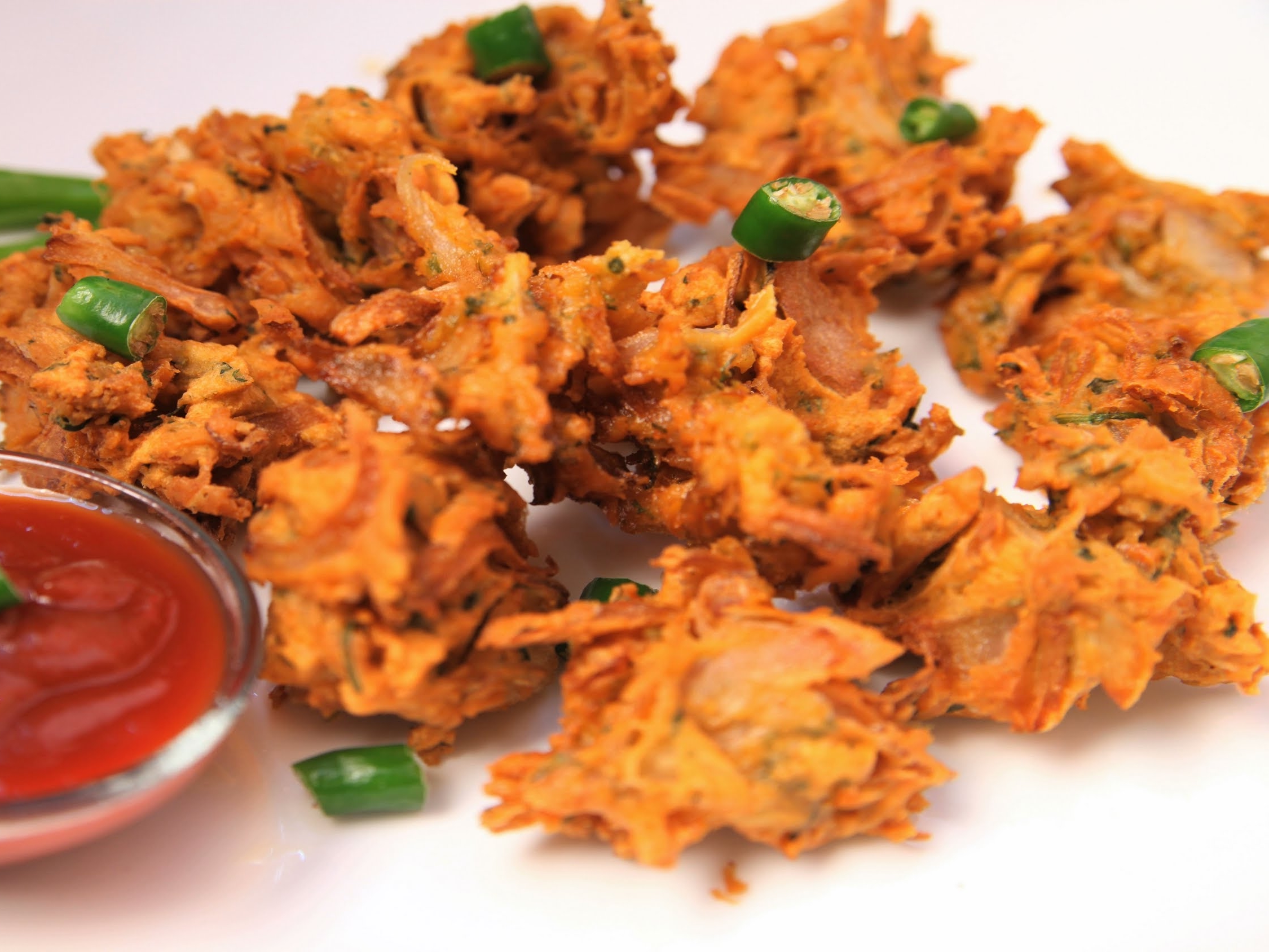
A restaurant and street vendor favourite, bhaji, bhajia, pakoras or pakodas all refer to much the same thing. They are thinly sliced vegetables, coated in a batter made of chickpea flour and then fried.
This is our recipe for onion bhaji, or vengaya bhaji.
This home-cooked recipe has much more onion than batter. The batter is just to hold the vegetables together. A curry house or a takeaway will do these as doughy fritters, which is not how they should be eaten. These are meant to be pieces of vegetable held together by the spiced batter.
Street vendors will take a handful of vegetables, drop them into the batter, shake off the excess batter, then deep fry them in front of you.
The most important thing is to get the oil temperature right. Too hot and they may burn, but certainly will leave the inside uncooked after the outside has browned. Too cool and the bhaji will absorb too much oil whilst cooking.
Check the oil by dropping a little batter into the oil. If it colours immediately, the oil is too hot. If it rises to the top, sizzles at the edges, and slowly darkens, the oil is about right.
Spices? Go to town. I have yet to eat a mildly spiced bhaji or pakora that I liked. Yet, you can overdo the level of spice, so be sure not to overdo the chilli level.
These need no accompaniment, other than your best tamarind and date chutney and an ice-cold Kingfisher beer. They don’t keep and are best eaten straight from the pan. Don’t expect any leftovers – the more you make, the more will be eaten.
They make an ideal afternoon snack, accompaniment to drinks, or as a starter to a meal. This recipe makes around eight generous bhaji.
If serving these as finger-food, make them a bit smaller and reduce the cooking time appropriately. I would also recommend that you make many more than you think you will need. They are very popular.
the recipe
about
equipment
- large bowl
- kadai
ingredients
for the batter
- 250 g chickpea flour - (besan)
- 1 ½ tbsp mustard oil
- 1 tsp salt
- 1 tsp carom seeds - (ajwain)
- ½ tsp asafoetida powder
- 4 cloves garlic - minced
- 3 green chillies - very finely chopped
- ½ cup coriander leaves - finely chopped
- 1 cup water
for cooking
- 1 brown onion - sliced (see notes)
- 1 red onion - sliced (see notes)
- 1 white onion - sliced (see notes)
- vegetable oil - for frying
instructions
- Sift the chickpea flour into a large bowl.250 g chickpea flour – (besan)
- Heat the mustard oil to medium, then pour it over the besan. It will bubble and needs to be stirred continuously until it cools.1 ½ tbsp mustard oil
- Add the salt, carom seeds, asafoetida, garlic, chillies and coriander and mix well.1 tsp salt, 1 tsp carom seeds – (ajwain), ½ tsp asafoetida powder, 4 cloves garlic – minced, 3 green chillies – very finely chopped, ½ cup coriander leaves – finely chopped
- Add the water, a little at a time until you have a thick pouring batter. Cover with film and set aside for 2½ hours.1 cup water
to cook
- Once the batter has rested, it will have risen a little and is ready for cooking. Add the onions and mix well, ensuring the onion is well coated in the batter.1 brown onion – sliced (see notes), 1 red onion – sliced (see notes), 1 white onion – sliced (see notes)
- Heat the frying oil in the kadai until quite hot. Test the oil by dropping a small piece of batter into it. If it sizzles and rises to the top without immediately colouring it is the right temperature.vegetable oil – for frying
- Using your hands, take a handful of onion mixture and squeeze it into a small flat pattie, no bigger than your palm.
- Carefully drop the bhaji into the oil and repeat the process, making sure you do not overcrowd the pan or allow it to cool. You may need to cook these in batches, depending on the size of your kadai.
- The bhaji are done when the batter is crispy golden brown on the outside and cooked through. The onions should still have some crunch.
to serve
- Turn bhaji onto absorbent paper to drain the oil, then serve immediately.
notes
private notes
This feature is only available to subscribers.