nargisi kofta curry
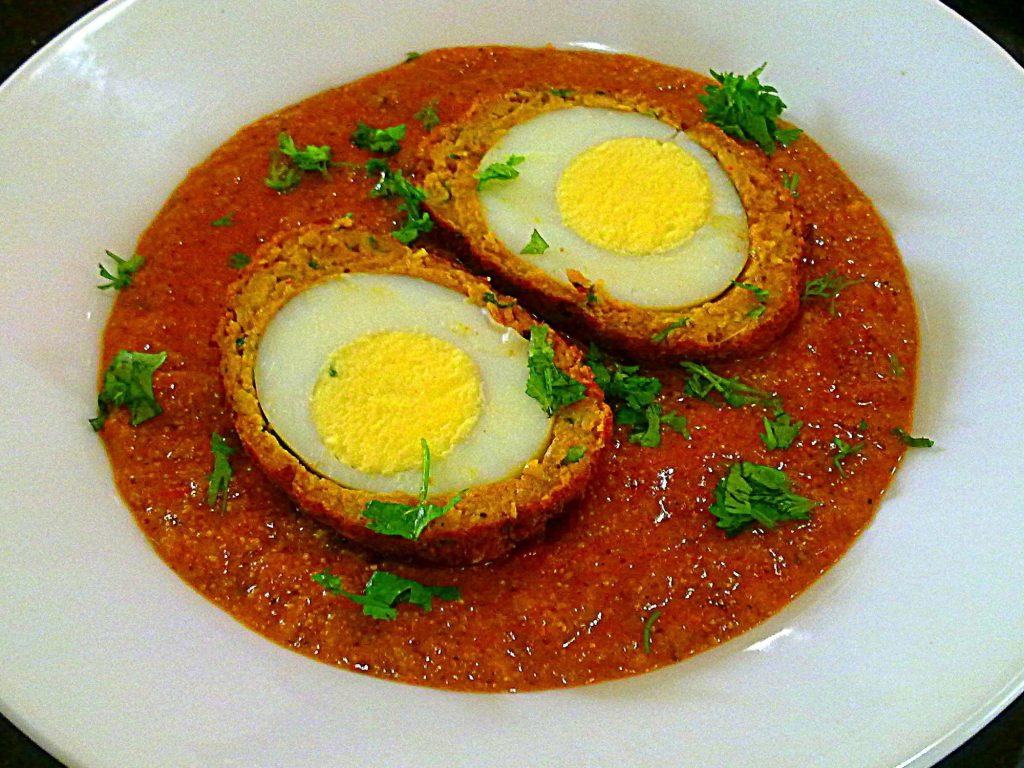
This is an Awadhi dish, featuring boiled eggs covered in spiced lamb and served in a spicy yoghurt and tomato gravy. A delicate and elegant way to serve eggs.
equipment
- small pot
- small frypan
- large bowl
- food processor
- kadai
- wide pan with lid
- slotted spoon
ingredients
for the nargisi koftas
- 4 eggs - large free range
- 3 tsp chickpea flour - (besan)
- 2 tsp white poppy seeds
- 1 tsp cumin seeds
- 3 cloves
- 8 black peppercorns
- 1 stick cassia - crumbled
- 1 black cardamom pod - broken open
- 750 g lamb leg - minced
- ½ tsp salt
- 1 tbsp dried fried shallots - (beresta)
- ½ tsp Kashmiri chilli powder
- 4 cloves garlic - minced
- 20 g ginger - minced
- ½ tsp pandanus essence - (kewra)
- 125 ml vegetable oil - to fry
for the gravy
- 1 tsp coriander seeds
- 1 tsp cumin seeds
- 2 tbsp vegetable oil - use leftover oil from the frying, above
- 2 brown onions - finely sliced
- ½ tsp salt
- 150 ml yoghurt
- 200 g tomato - pureed
- 20 g ginger - minced
- 2 cloves garlic - minced
- 1 tsp ground turmeric
- 1 tsp Kashmiri chilli powder
- 250 ml water - hot
for serving
- 1 tbsp coriander leaves - chopped
instructions
for the eggs
- Using a pin, prick the rounded bottom of each egg. Place them in a small pot and add enough cold water to cover them Bring the water up to a simmer, then cook for five minutes. Remove from the heat, pour out the water, and cover eggs with cold water to stop the cooking process. You may need several changes of water to cool the eggs.
- Once cooled, carefully peel the eggs, under gently running water. Cover and refrigerate until ready to use.
to cook the koftas
- Heat a small frypan over medium heat. Add the chickpea flour and stir continuously until the flour becomes golden. Remove from the heat, transfer toasted flour onto a plate and set aside to cool.
- Place the poppy seeds, cumin seeds, cloves, black peppercorns, cassia, and black cardamom into the heated pan and return to the heat. Stirring frequently, toast the spices until they become aromatic. This will only take a few minutes. Remove from heat and allow to cool. Grind spices to a fine powder.
- Place the lamb mince, ground spices, salt, fried shallots, Kashmiri chilli powder, garlic, ginger and pandanus essence into a food processor. Process to a smooth velvety texture. Transfer to a large bowl.
- Add the toasted chickpea flour to the lamb mix and knead until well combined.
- Divide lamb mix into four equal portions. Using wet hands, flatten a portion into a disk, place a peeled egg onto the disk and gently wrap the lamb around the egg. Wet your hands again and roll the kofta in the palm of your hand to make sure it is sealed and smooth. Repeat for the remaining eggs and lamb portions.
- Heat a kadai or wok over medium heat and add the oil. Once hot, add the koftas. Depending on the size of the pan you may need to do this in batches as you do want to crowd the pan. Don't move the koftas too much whilst browning as you do not want them to break up. Instead, baste them with the hot oil until browned all over. The lamb does not need to be to be fully cooked at this point, because they will finish cooking when poached in the sauce. Remove from the pan, place onto absorbent paper and continue browning the rest. Set aside.
to cook the gravy
- Place a small frypan on medium heat and add the cumin and coriander seeds. Toast the spices until they become aromatic then remove from the heat. When cool enough to handle, grind to a fine powder. Set aside.
- Heat a wide pan that is just large enough to hold the koftas in one layer and add the oil. Once the oil is hot, add the sliced onions, sprinkle with the salt then cook over medium-low heat until the onions become a golden colour. This should take around ten minutes. Remove the pan from the heat and, using a slotted spoon, transfer the onions to a plate. Set aside to cool.
- Once the onions have cooled, add the onions and yoghurt to the food processor and blend until smooth.
- Add a little more oil to the pan if necessary. Carefully add the onion paste back to the pan, mix well and return to the heat. Cook for a few minutes, stirring well, until it is a golden brown and the oil is separating.
- Add the pureed tomatoes, ginger, garlic, turmeric, Kashmiri chilli powder and the ground cumin and coriander seeds. Fry until the raw tomato and garlic smell has gone. This should take around five minutes and the sauce should be rich and thick. Reduce heat to a low simmer.
- Add enough hot water to the gravy to make a thick consistency. Place the koftas into the gravy. Allow the pan to come back to a simmer and spoon the gravy over the koftas. Cover and cook on a low heat for 20 minutes, occasionally gently turning the koftas and keeping them covered in gravy.
to serve
- Remove the pan from the heat and transfer the koftas to a plate. Pour the gravy into your serving plate, reserving a little. Halve the koftas and place on the plate cut side up. Drizzle over the remaining gravy, garnish with coriander leaves and serve.
notes
- Beresta are thinly sliced crispy fried shallots and are available from most Indian grocers. The Chinese variant is a suitable substitute.
- Kewra is an extract that is distilled from pandanus flowers. A good Indian grocer will have this.
private notes
This feature is only available to subscribers.
nutrition
Serving: 250 g | Calories: 377 kcal | Carbohydrates: 17 g | Protein: 34 g | Fat: 19 g | Saturated Fat: 9 g | Cholesterol: 244 mg | Sodium: 764 mg | Potassium: 799 mg | Fiber: 3 g | Sugar: 6 g | Vitamin A: 990 IU | Vitamin C: 12.8 mg | Calcium: 145 mg | Iron: 4.9 mg

All rights reserved.
Printed on 20 September 2026
To see the online version scan the QR code or visit https://cookbook.pfeiffernet.dev/nargisi-kofta-curry/