roast chicken
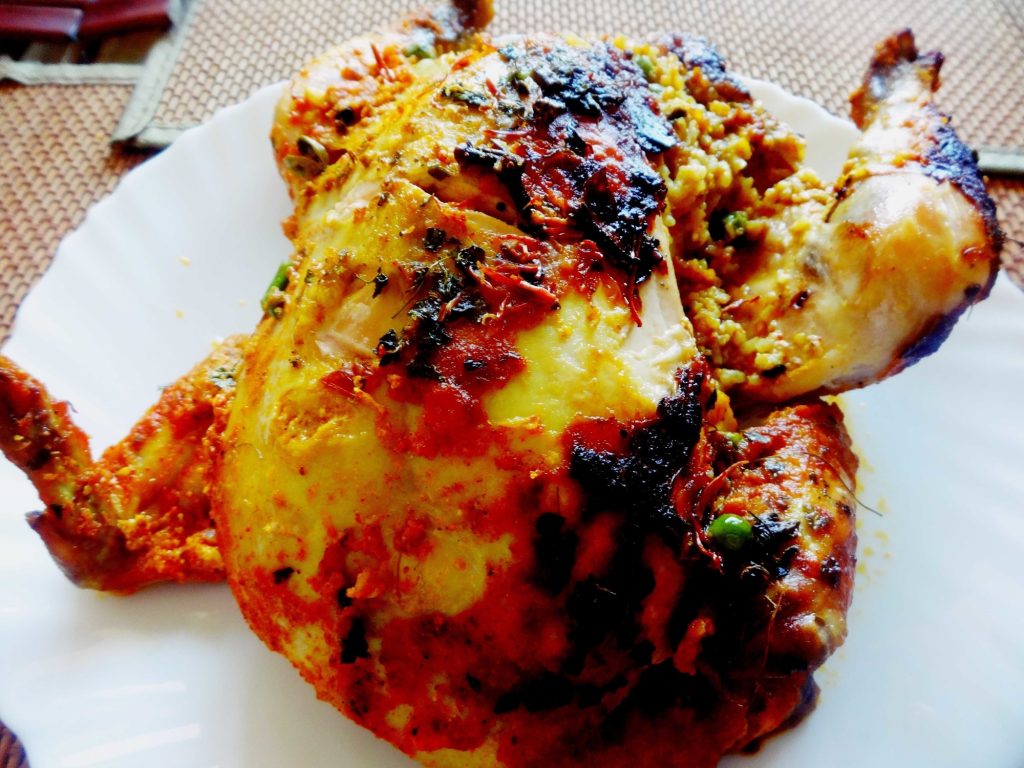
This roast chicken, murgh musallam, is very popular in the north and north-eastern parts of India. Another great example of Mughal cuisine, it is mildly spiced, with a thick and rich yoghurt and tomato sauce.
equipment
- large bowl
- large pot
- sieve
- 2 roasting pan
- wide pan
- skewers
- kitchen twine
ingredients
- 1.5 kg chicken - free range
for the marinade
- 150 ml yoghurt
- 20 g ginger - minced
- 8 cloves garlic - minced
- 1 tsp ground turmeric
- 1 tsp Kashmiri chilli powder
- 1 tsp garam masala
- 8 black peppercorns - crushed
- ½ tsp salt
- ½ lemon - juiced
for the rice and stuffing
- 400 g basmati rice
- 1 tsp salt
- ½ cup almonds - halved
- ½ cup dried fruit - finely diced (see notes)
for the masala
- 20 g ginger - coarsely chopped
- 6 cloves garlic - coarsely chopped
- 2 tomatoes - pulp removed and pureed
- 3 tbsp vegetable oil
- 1 brown onion - finely sliced
- ½ tsp salt
- 1 tsp ground turmeric
- 1 tsp Kashmiri chilli powder
- ½ tsp black peppercorn - crushed
- 150 ml yoghurt
for cooking
- ½ lemon
for serving
- 1 green chilli - finely sliced
- 25 g almonds - slivered
- ½ cup coriander leaves - finely chopped
instructions
- Dry the chicken, then lightly score the skin to allow marinade to soak in. Set aside whilst preparing the marinade.
to marinate
- Put the yoghurt, ginger, garlic, turmeric, chilli powder, garam masala, black pepper, salt and lemon juice into a large bowl and mix well.
- Place the chicken into the bowl and work the marinade into the surface and cavity. Cover, and set aside in a refrigerator overnight.
to cook rice and stuffing
- Bring a large pot of water to a rolling boil. Add the rice and salt and stir. Cook until rice is about half cooked – you should just be able to break a grain with your fingernails. Take ½ cup of the rice from the pot, drain using a sieve, then set aside in a bowl for the stuffing.
- Add half the almonds and dried fruit to the remaining rice in the pot and cook for a further minute or so. The rice should still be a little undercooked.
- Remove the pot from the heat, drain using a sieve, and when still moist, but not wet, turn into a roasting dish, cover tightly and set aside.
- For the stuffing, add the remaining almonds and fruit to the reserved ½ cup of rice and mix well. Set aside.
to cook the masala
- Make a thick paste from the ginger, garlic and a little water.
- Heat a pan over a medium-high heat, then add the oil. When hot, add the onions, sprinkle with salt and cook, stirring often until onions become golden brown – around ten minutes.
- Carefully add the ginger and garlic paste to the pan and cook until the raw garlic smell has gone, or around five minutes.
- Add the pureed tomatoes, turmeric, Kashmiri chilli powder, and black pepper to the pan. Mix well and cook for five minutes or until tomatoes soften.
- Reduce the heat to low and carefully add the yoghurt to the pan one tablespoon at a time, mixing well before adding the next spoonful. Cook, stirring frequently, for around five minutes or until the sauce is smooth and starting to thicken. Remove from the heat and set aside until cool enough to handle.
to cook
- Pre-heat the oven to 180 °C.
- Stuff the chicken with the rice, nut and fruit stuffing mixture, pressing firmly. Place the lemon half, cut side inwards to seal the cavity and use skewers or toothpicks to close it. Use kitchen twine to tie the legs together.
- Place the chicken on aluminium foil and cover with the masala. Fold the foil up over the chicken, and tightly seal. Place into a roasting dish just large enough to hold the chicken. Refer to the notes below.
- Place the chicken into the oven and cook for one hour.
- Remove the chicken from the oven and carefully open then fold back the foil. Spoon the accumulated liquid over the chicken and return to oven. Place the covered roasting dish with rice in the oven at the same time. Increase oven to 200 °C .
- Cook the chicken and rice for a further 30 minutes, basting the chicken in the juices every 10 minutes or so. By this time the juices should have thickened considerably, and the chicken should be a golden brown.
- Remove rice and chicken from oven and rest for 10 minutes.
to serve
- Turn the rice onto a platter in a ring, leaving some space in the middle for the chicken.
- Carefully remove the chicken from the foil, place into the middle of the platter and remove skewers and twine. Remove the lemon half from the chicken cavity, set to one side of the platter, and gently ease some of the stuffing out of the chicken.
- Pour any remaining sauce from the foil pouch over the chicken, then garnish with the sliced green chilli, almonds and coriander. Serve.
notes
400g of uncooked rice is approximately two metric cups.
We use dried tropical fruit for the rice and stuffing. Dried mango and papaya work well.
To wrap the chicken, join two aluminium foil sheets by folding them together along the long edge with a double-folded seam. That seam goes to the bottom and allows you to bring the sides up over the chicken to seal it.
If you want to be traditional, you could use a banana leaf to wrap the chicken instead of foil. Warm the leaf first to make it more pliable, but be warned that wrapping the chicken is a difficult task.
private notes
This feature is only available to subscribers.
nutrition
Serving: 275 g | Calories: 718 kcal | Carbohydrates: 107 g | Protein: 17 g | Fat: 26 g | Saturated Fat: 11 g | Cholesterol: 9 mg | Sodium: 1272 mg | Potassium: 806 mg | Fiber: 8 g | Sugar: 11 g | Vitamin A: 1120 IU | Vitamin C: 30.4 mg | Calcium: 229 mg | Iron: 3.1 mg

All rights reserved.
Printed on 20 September 2026
To see the online version scan the QR code or visit https://cookbook.pfeiffernet.dev/chicken-roast/